AI is becoming a key topic in cybersecurity. In the SOC, the expectation is clear: faster analysis, better decisions, and less manual work. However, the reality inside most SOCs is very different. Most teams are not struggling to find data, they are struggling to understand it. Alerts keep increasing, tools keep generating more signals, and analysts are expected to make the right decisions under pressure.
This is what many SOC teams deal with every day. Alerts keep increasing, incidents keep coming, and the pressure never stops. On paper everything appears under control, SLAs are met, dashboards are green, and metrics suggest stability. But behind the screens, analysts are overloaded, exhausted, and trying to keep up with the endless stream of decisions.
Before looking at how AI can help, it’s important to understand the real problem, not the volume of alerts, but the human cost of making sense of them.
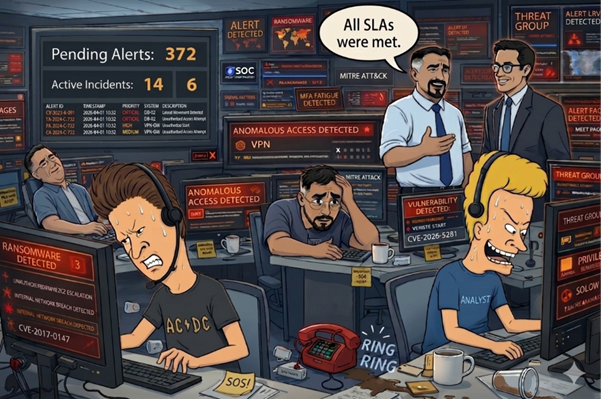
The Reality: Alert Fatigue and Burnout
Modern SOC teams face a growing challenge. As attacks become more sophisticated, organisations respond by deploying more tools to keep pace. SIEM platforms, endpoint protection, identity monitoring, cloud security solutions, and increasingly AI‑enhanced capabilities are now standard. Solutions such as Microsoft Defender XDR and CrowdStrike already use AI to correlate alerts, group related activity into incidents, and reduce noise across multiple data sources. Despite these advances, the problem remains unresolved.
Correlation is still imperfect, and the context provided is often insufficient to support confident decision‑making. Analysts must move between dashboards, review disparate data points, and manually piece together what is happening. Too much time is spent assembling the picture, leaving less time to act on it. As a result, alert fatigue sets in: when everything looks urgent, prioritisation becomes difficult, important signals can be lost in the noise, and operational efficiency begins to decline.
The issue is not a lack of data – there is already an abundance of it. The real challenge is clarity. More alerts do not create more security; better decisions do. And the impact of this challenge extends beyond the technology itself to the people responsible for interpreting and responding to it.
Security Operations Centres ultimately depend on human judgment. Every alert, incident, and escalation requires an analyst to assess risk and decide on the next step. Analysts may make dozens, sometimes hundreds, of decisions per shift, often under time pressure and with incomplete information. Over time, the constant mental effort takes a toll on how well decisions are made. Important details are more easily overlooked, alerts may be closed prematurely, and investigation depth becomes inconsistent.
At the same time, the stakes remain high. Missing a genuine threat can result in financial loss, operational disruption, or reputational damage. This pressure causes everything to feel critical, pushing analysts toward worst‑case assumptions even though most alerts are not true threats.
The combination of alert overload, sustained decision pressure, and the fear of missing something important creates a direct path to burnout. And burnout is not just a human issue- it becomes a security risk. When the people responsible for protecting the organisation are overwhelmed, the organisation itself becomes more vulnerable.
From Alerts to Decisions: A Phishing Scenario
To understand how these challenges appear in practice, consider a common phishing scenario and how the same incident unfolds in two different SOC workflows: one without AI support, and one with it.
A user receives an email that appears to be a legitimate DocuSign request. The message looks convincing and matches normal business communication. The user clicks the link and enters their credentials.
Within minutes, multiple alerts are generated across different security systems.
Without AI: A Traditional SOC Workflow
In a traditional SOC workflow, these alerts appear separate, unconnected signals. The analyst may see:
- a suspicious sign-in from a new location
- multiple authentication attempts in a short period
- repeated MFA prompts
- access to applications not normally used
- creation of a new inbox rule
- Potential malicious link clicked
Each alert represents only a fragment of the story. To understand what is actually happening the analyst must manually piece everything together.
This typically involves:
- Switching between tools and dashboards
- Reviewing sign-in logs and user activity
- Analysing device behaviour
- Building a timeline of events
At this stage, the focus is not on making a decision but trying to understand the situation. This takes time experience and focus. Meanwhile, new alerts continue to arrive, adding pressure.
Key questions need to be answered:
- Is this a real compromise or normal behaviour?
- Has the account been taken over?
- What actions should be taken?
These decisions are made under pressure and often with incomplete visibility. The risk of missing something important is always present.
Now consider how the exact same scenario appears in an AI‑supported SOC.
With AI: AI-Supported SOC
With AI-supported platforms, the same scenario is presented very differently. Instead of isolated alerts, related activity is automatically grouped into a single incident. The analyst sees:
- the suspicious sign-in
- the sequence of authentication attempts
- the MFA activity
- the unusual application access
- the mailbox rule creation
All connected as part of one coherent chain of events. Additional context may already be available, such as:
- unusual location or device events
- deviation from normal user behaviour
- risk indicators based on previous activity
The investigation no longer starts with scattered data; it begins with a clear picture. AI connects related activity, highlights what is most relevant, and helps prioritise the investigation, allowing analysts to focus on validating risk rather than assembling information. The decision still belongs to the analyst, but it is now made with better context, less noise, and a more complete understanding of the situation.
AI in the SOC: Supporting Better Decisions
By now, it’s clear that SOC teams aren’t constrained by a lack of data, but by the challenge of turning overwhelming volumes of information into confident, timely decisions. This is where AI delivers meaningful value.
AI does not replace the analyst. It improves how information is organised, connected, and presented, allowing investigations to begin with a structured view of what matters most rather than scattered alerts. This reduces friction in the workflow and enables analysts to focus on understanding risk instead of searching for data. Decisions remain human, but they are made with better context, less noise, and greater consistency.
This is where Ergo can help! By combining deep security expertise with practical experience of modern SOC environments, Ergo works with organisations to design, implement, and optimise AI‑enabled security operations that genuinely support analysts. This includes selecting and integrating the right platforms, improving investigation workflows, and ensuring AI capabilities are applied in ways that enhance clarity and decision‑making, not complexity.
This is the real impact of AI in the SOC. Security improves not by handling more alerts, but by enabling better decisions at the right moment. Strengthening how those decisions are made is what protects the organisation, and the people behind it.
Learn more about Ergo’s cyber resilience and cyber recovery services
Read More